

Thank You, Thank You Silence
In the Age of Noise.

Listening to a rock song is a weird way to be reminded of the value and necessity of silence.
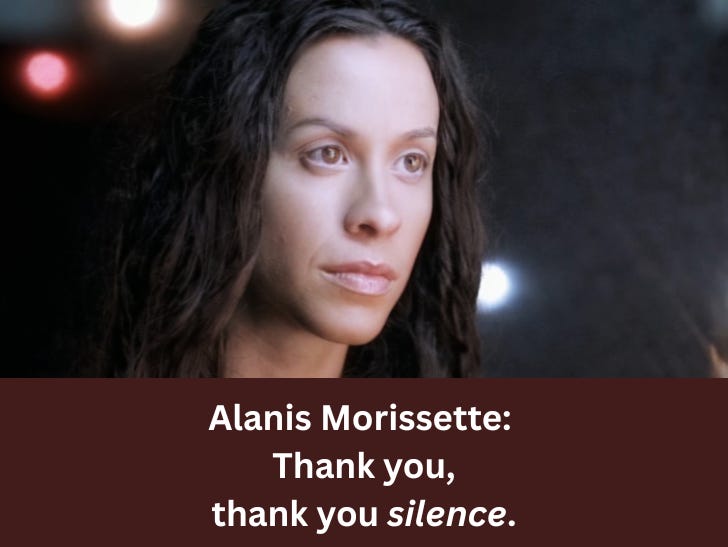
But that’s what happened to me the other day when my Spotify playlist, in random mode, spit out Alanis Morissette’s “Thank U.”
If you’re not familiar with, or have simply forgotten the song, Morissette presents a laundry list of things that helped restore her mental health.
Here’s the chorus:
“Thank you India
Thank you providence
Thank you disillusionment
Thank you nothingness
Thank you clarity
Thank you, thank you silence”
She’s not just thanking silence. She’s double-thanking it.
(Quick digression: It reminds me of God’s running commentary on Creation in Genesis 1. After each day, God describes things as “good,” but once the Divine edict to eat plants and only plants is presented, God describes things as “very good.”)
Silence isn’t just another element of mental hygiene, Morissette is telling us. It’s doubly important. I dare say essential.
“Thank U” hit the airwaves in 1998, before the arrival of smartphones. If she wrote the song today, she would have triple-thanked silence.
Similarly, the comedian Bill Hicks, who died in 1994, once said: “Watching television is like taking black spray paint to your third eye.” If he had lived long enough to see smartphones, Hicks would have said, “Scrolling is like gouging out your third eye with a melon scoop.”
The constant pinging of notifications, the ceaseless availability of music and podcasts, the tidal wave of TikTok videos – how can anyone stay sane?
We would much rather distract ourselves than look within ourselves. When we gaze within, we might not like what we see – and that’s why it is so important that we take a look.
You don’t need The Alignment to inform you that smartphones are having a horrible effect on us. That subject has been extensively explored elsewhere.
What I’m suggesting is that we need to take the next step. It’s not enough to set aside our smartphones on a regular basis. We need to create or seek out intervals and spaces of silence.
Of course, smartphones are not the only source of the problem. While I’m convinced that we need to restore our focus on climate change, noise pollution is also degrading our experience and our planet.
For the love of God, why must so many restaurants blast music, forcing diners to shout at each other in order to make themselves heard above the din?
Leaf blowers, meanwhile, do double-duty damage, contributing to climate change through carbon exhaust and imitating the sound of jet engines, in residential neighborhoods.
And there is a seeming epidemic of logorrhea, the actual term for excessive and uncontrollable talkativeness. I’ve come across it in podcasts, on talk radio, and even in my personal life.
There is a reason Buddhists hold weeklong silent retreats, rather than nonstop talking retreats.
There is a reason meditators generally practice first thing in the morning, before noise interrupts.
Silence is the gateway to our souls.
In recognition of this, a minute of silence is a regular element of Shabbat services at my Reform synagogue. But it is only a minute, just enough to stick your toe in the gateway.
On my honeymoon, 20 years ago, one of the most memorable – and enjoyable – moments was an experience of deep silence. On the Swedish island of Gotland, my wife and I stumbled upon a deserted pier in an undeveloped area. There were no people, no cars, no buildings. Just a few waterfowl, whose occasional squawks could be clearly heard from 100 yards away.
We sat on the pier, saying nothing, serenely listening to the silence – if that makes sense. It was as if time had stopped. We were at peace, profoundly so. I didn’t want to leave that spot, but the memory of it remains embedded in my soul.
William Penn, the founder of the Commonwealth of Pennsylvania, once said:
“True silence is the rest of the mind, and is to the spirit what sleep is to the body.”
The Norwegian explorer and author Erline Kagge was the first person in history to reach the North Pole, South Pole and the summit of Mount Everest on foot. You could say he went to great lengths to find peace and quiet.
In his book “Silence: In the Age of Noise,” he wrote:
“Silence is a key to unlocking new ways of thinking. I don’t regard it as a renunciation, but rather a practical resource for living a richer life.”
Without silence, how can we contemplate the meaning of our lives, connect with our souls or a Higher Power, examine our actions and habits, and recommit to positive change?
Silence is nourishment. Without it, how can we restore our mental health?
I’m with Alanis Morissette. Thank you, thank you silence.
Good thoughts. I grew up with a father blaring Count Basie records in our living room. Basie was known as a jazz piano player who understood the value of leaving silence between his notes. Not to demean your fine essay with a dose of commercialism and a paean to American entrepreneurship, but I think the assault on silence in the private sector all started with elevator music, then big department stores and the growth of Musak, which was invented in 1934. https://en.wikipedia.org/wiki/Muzak The birth, evolution and death of Musak is both amazing and depressing, especially when the behavioral scientists started programming the 'music' to make people work or shop more productively or to pacify captive audiences with sleepy/dreaming sounds in the same way some folks -- not me! -- think our beloved government's geo-engineers are doing with their contrails/chemtrails experiments. And if you value silence and your sanity, do not attend any major league sporting event, especially hockey. And let's give rocker Ted Nugent some credit -- he once offered to buy Musak for $10 million with the sole purpose of shutting it down.
I'm OK with the manufactured noise at hockey games, since it's in keeping with the sport's vibe. But the between-inning t-shirt and hot dog tosses at Pirate games, with the musical noise and human inanity, drives me crazy.
Devo, one of my favorite bands, did a wonderful job lampooning the corporate-driven rise of Muzak. On their tour in '81, they played recorded Muzak versions of their own songs before the actual concert started.