

Passover Is So Back
Good time for a refresher on the holiday's spiritual themes.

If there is a first time for everything, and if the exception proves the rule, what you’re about to read is living proof.
Here at The Alignment, we have a long list of ideas for future posts, and we like to keep things fresh. So I would never dream of republishing a past post.
Except this one time.
The reality is, The Alignment — thankfully — has picked up a lot of new subscribers since the following first appeared in April of 2024. And even if you’ve been here from the very beginning, a little refresher on the spiritual basis for a vegan Passover wouldn’t hurt you, would it?
So, this one time only, I present to you – again – the reasons for a plant-based Passover.
The spiritual themes of the Passover holiday are tightly intertwined with veganism. In fact, if we’re taking the meaning and insights of Passover seriously, then every Seder should be vegan.
That might sound audacious, until you consider these three core aspects of the holiday:
1) We repeat the Passover story primarily to remind ourselves of our ancestors’ experiences in slavery and to recommit ourselves to ending oppression in our time. The oppression of animals and workers in modern animal agriculture is massive in scale and bottomless in depravity.
2) During Passover, we avoid chametz (anything with yeast) and eat unleavened bread to reaffirm the virtue of humility. In contrast, the whole concept of confining, killing, and consuming animals is based on the misguided idea that human beings are far superior to our feathered, furry, and scaly friends.
3) Spiritually, Passover presents an opportunity to free ourselves from our personal enslavement to bad habits. Given the ethical, health, and environmental consequences of consuming animal products, switching to a plant-based lifestyle is liberating for all involved.
Did you know that you can veganize your Seder Plate while still adhering to Jewish practice?
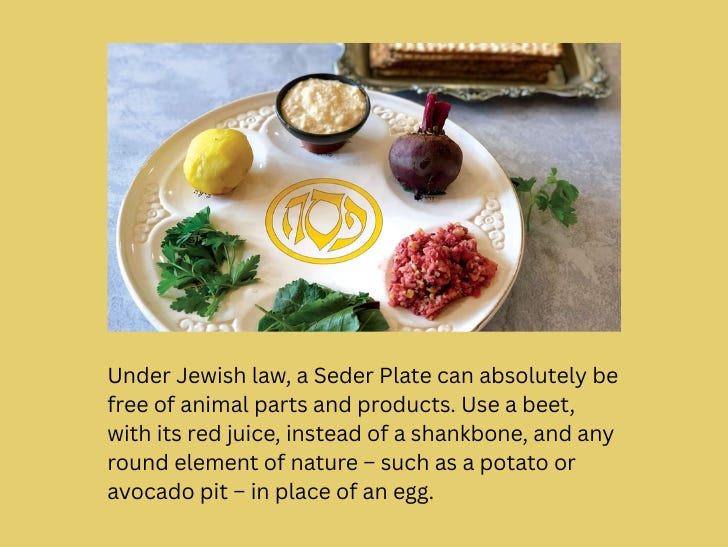
The Seder Plate, the centerpiece of the Passover table, has six items on it. Traditionally, four of the items are plant-based, and two are animal products. However, during the Seder itself, we only eat the four plant-based items (typically matzah, horseradish, parsley and an apple-nut mixture called charoset), while the two animal products (typically an egg and shank bone) are purely symbolic.
And because they’re purely symbolic, they can be replaced with plants that serve the same symbolic purpose. For instance, the egg, as a symbol of spring and rebirth, can be replaced with a flower or an avocado pit. And the shank bone, under Jewish law, can be replaced with a beet, whose juice resembles blood.
What about the meal itself? PETA has you covered with vegan Passover recipes on its website.
So, as you have seen, it’s not audacious at all to suggest that every Seder should and can be vegan.
All of us at The Alignment, meaning me, wish you a meaningful and joyful Passover.
Chag Pesach Sameach!
Amen to you and Ellen. Never apologize for repeating a message we can never hear enough. Apparently "repetition" is one of the many strokes of genius of our forefathers. I believe & pray "one day" this will come to pass. Yes, Jeff and Ellen, we must persevere regardless. 🙏🏻♥️🙏🏻
Jeffrey, this is the value of Passover and all holidays and rituals. They make us stop and consider why we do what we do. Thank you for the reminder, thank you for The Alignment.. Here's to a compassionate Pesach -- for all of us.