

Out for Vengeance
Where was the God-Human partnership during the Holocaust?

One of my favorite jokes goes like this:
A guy who is hard on his luck – whose car has been repossessed and whose rent has been unpaid – prays to God to win the lottery.
The week’s lottery comes and goes, and the man doesn’t win.
“God, c’mon,” the man implores. “The bill collectors are calling at all hours of the day and night.
“Help me out here God. I need to win the lottery.”
Again, the guy fails to win the lottery.
Now, the man is on his knees.
“Please God. I’m desperate. How can you forsake me? I need to win the lottery.”
God, in a booming voice, replies to the man.
“Help me out here. Buy a f*#king lottery ticket!”
Ba-da boom.
This is a Jewish joke with a serious message.
We’re not supposed to sit back passively and wait for things to get better. We have to do our part, as partners in Creation with God.
I have a hard time remembering jokes, but this one came back to me recently, albeit at an inappropriate time: While reading the deathly serious novella “Vengeance Is Mine,” by Friedrich Torberg.
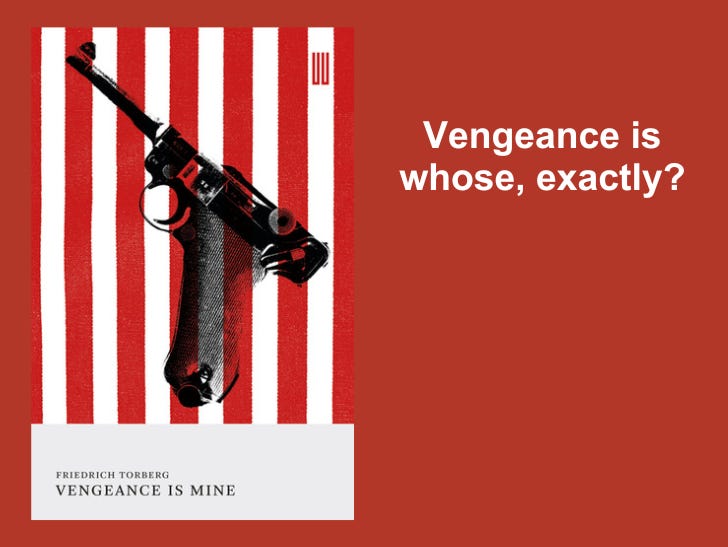
Translated to English and released in the United States in March of this year, “Vengeance Is Mine” is a rare piece of Holocaust fiction that was written during the Holocaust, not afterward.
First published in German (not in Germany, but in the German language) in 1943, the story takes place in a small concentration camp, whose commandant is utterly ruthless and a true believer in the Nazis’ genocidal ideology.
In the barracks, the prisoners debate whether they should plot an act of revenge, or leave vengeance in the hands of God.
Quoting Deuteronomy 32:35, a character described as a former rabbinic student reminds his fellow prisoners “To Me belongeth vengeance and recompense, sayeth the Lord.”
One of the hardest things about being Jewish is that the religion forces you to sort out competing, contradictory demands. We’re supposed to be partners in Creation, yet we’re supposed to let God take care of vengeance?
Look, I get it. Human beings have done a lot of horrible things in the pursuit of vengeance. I can totally understand why the authors of the Torah wanted to carve out an exception to the God-human partnership and leave vengeance to God and God alone.
But in a concentration camp, where every Jewish prisoner was marked for death, waiting for God to do something wasn’t very satisfying, to put it mildly.
Torberg, to his credit, leaves this tension between human action and Divine prerogatives unresolved. In fact, in my reading, that’s the point of the novella. Or at least a point.
In life, you almost always have a choice. But sometimes, you have nothing but bad options. During the Holocaust, for the vast majority of Jews who were caught in the Nazis’ vice, passivity and action produced similar, devastating results.
Maybe that’s the real point of the novella.
“Vengeance Is Mine” is a remarkable piece of realistic fiction, written while the Holocaust was unfolding. This is not Spielberg’s “Schindler’s List” or Benigni’s “Life Is Beautiful.” There is no redemption, no gloss, in Torberg’s book. It is unsparing.
Why this novella was unknown and inaccessible to English readers until this year, I cannot fathom.
Now that I’ve had a chance to read it, the only thing I can do is recall a joke – and shake my fist at God.
One of the hardest lessons in life that I have lived and learned is that in the end evil never wins, forgive but never forget.