

Our Greatest Failing
Organized violence against our fellow creatures.

Here at the Alignment, I like to think that I’m fairly articulate and eloquent in writing about the evils of animal agriculture.
But I also like to stay humble. So if I come across someone who communicates about this weighty matter even better than I can, I’m more than happy to yield the floor.
In that spirit, I’d like to share some excerpts from an essay written by Marina Bolotnikova, an editor at Vox, an online publication that runs laps around the rest of the mainstream media in its coverage of the cow-, chicken- and fish-killing industries.
Normally, I’m pretty stoic. OK, very stoic. Even the ending of Old Yeller left me unfazed.
But I was almost moved to tears – when I wasn’t feeling outrage – while reading Bolotnikova’s essay “Humanity Is Failing One of Its Greatest Moral Tests.”
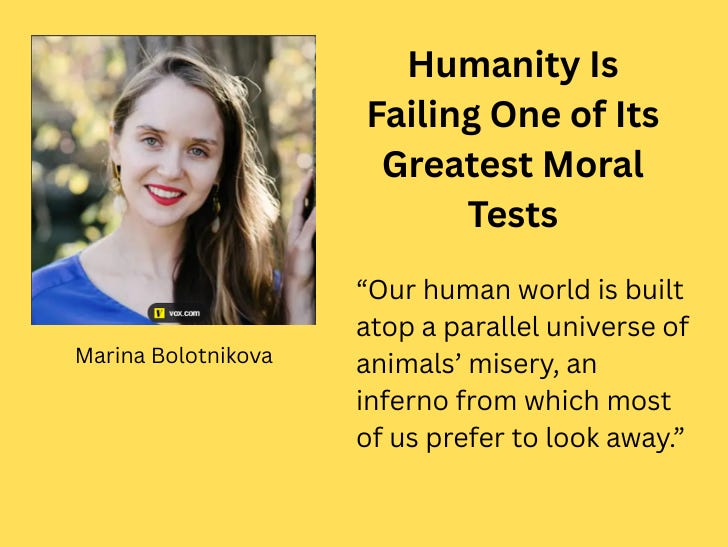
If you’ll indulge The Alignment, I’d like to share a few excerpts and comment briefly on them.
She starts this way:
“If you can stand to think about it long enough, the problem becomes paralyzing. Tens of billions of land animals slaughtered every year; hundreds of millions every day; thousands in the time it takes to read this sentence. The number grows by billions more every year, into multiples that feel as abysmal as they are mind-numbing.
“On top of 80 billion, how can we comprehend another 5, 10, 20 billion more? How can it get worse? And while we can count suffering in the aggregate, these animals experience it as individuals, each one containing an infinite depth of conscious experience. Our human world is built atop a parallel universe of their misery, an inferno from which most of us prefer to look away.”
Not to blithely draw comparisons between the Holocaust and modern animal agriculture, but the problems Bolotnikova lays out should resonate with all Jews, vegan or not. To this day, we struggle in futility to convey the enormity of the Holocaust, whose victims were also endowed with “an infinite depth of conscious experience.”
And if people prefer to look away from the horrors of factory farming, the industry makes it easy to do so, hiding its cruelties in windowless warehouses in rural areas.
Bolotnikova continues:
“Factory farming has deployed modern agricultural, biomedical and financial technologies to put the exploitation of animals to astonishing new extremes. Modern farmed animals’ bodies have been hyperoptimized for productivity without regard for welfare. The livestock industry, with the aid of the US government, is continually testing how far animals can be pushed to yield more meat and more offspring.”
As a general rule, whenever someone’s income depends on an animal, it turns out badly for the animal. In animal agriculture, the depth of the cruelty is bottomless, all in the name of financial gain and stock prices.
As Bolotnikova points out, the drive for greater productivity and efficiency has no ending point. It’s only going to get worse and worse on factory farms, as hard as that is to believe.
She concludes with a message that is inspiring, if not exactly optimistic.
“We need to see the animal liberation movement as part of a very early vanguard. Today’s animal activists are laying the foundation for a future that people alive today may never see – a humbling realization but also, perhaps, an empowering one.”
This much, I feel fairly certain about: A future generation will judge us harshly for how we’re mistreating animals, for what Bolotnikova refers to as the “organized violence against our fellow creatures.”
Today’s vegans will be exempt from Future’s judgment. That’s some comfort, I suppose, as we go about trying to get people to join our movement, or to at least emulate and adopt our way of peaceful living.
Hooray for the truth tellers!
A relatively new book called the Omnivore’s Deception by John SANBONMATSU goes into more detail on this subject. It’s subtitle is: what we get wrong about meat, animals, and ourselves. I recommend it.