

Going West
For wisdom.

Since the 1950s, spiritual seekers have looked East for enlightenment and happiness – to Buddhism, yoga and Zen.
In doing so, however, we have downplayed and even ignored sources of wisdom that originate in locations closer to home.
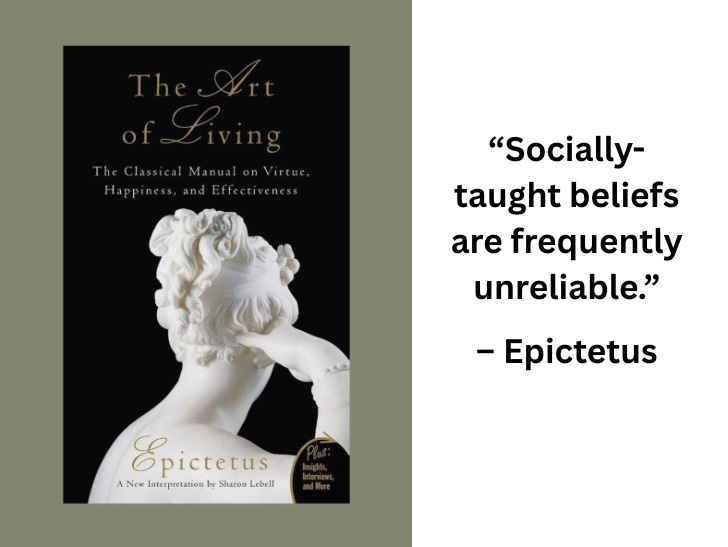
This hit me recently while reading “The Art of Living,” a collection of short precepts and prescriptions for achieving tranquility and satisfaction, based on the writings of the Stoic philosopher Epictetus.
I doubt Horace Greeley had Stoicism in mind when he exhorted newspaper readers to “Go West, young man.” But diving into the teachings of Epictetus is more fruitful than buying a tract home in the San Fernando Valley.
There is a reason Stoicism is making a comeback after a 1,800-year hiatus.
I would still recommend meditation and yoga as important practices for maintaining sanity and flexibility, but the “Art of Living,” in a mere 125 pages, gives you just about everything else you might need to get your poop together, if you’ll forgive the technical term.
The value proposition of the Stoics in general and Epictetus in particular boils down to one word: virtue.
Compassion, a centerpiece of Buddhism, is in short supply in modern society, but so is virtue. We need both. A lot more of both.
Virtue, as Epictetus defines it, is about focusing on something – and someone – other than yourself.
“Our duties naturally emerge from such fundamental relations as our families, neighborhoods, state or nation,” Epictetus taught. “The morally trained immerse themselves in their duties, to their family, friends, neighbors and job.”
If this sounds old-fashioned, that’s a problem.
In the modern mind, the very word “Stoic” connotes maintaining a stiff upper lip and suppressing emotions in the face of adversity. But this perception does a disservice to both Stoicism and to ourselves.
The Stoics, like the Buddhists, were concerned about our peace of mind. OK, not our peace of mind. But the peace of mind of their fellow Romans, anyway.
Trying to make yourself happy is a sure-fire way to make yourself unhappy, just as trying to fall asleep is the recipe for insomnia. Epictetus advises that the path to lasting happiness is a byproduct of virtue – not wealth, possessions, or status.
“The one who achieves tranquility is the one who has formed the habit of asking on every occasion,’What is the right thing to do now?’" he wrote.
Epictetus – like today’s Alcoholics Anonymous – emphasizes differentiating between situations within our control and situations outside of it.
“Trying to control or to change what we can’t only results in torment,” he wrote.
This differentiation, though, requires some nuance that is missing from “The Art of Living.”
I think about this often in the context of vegan advocacy.
We absolutely cannot control animal agriculture (or abolish it) and we cannot make anybody go vegan (I wish we could).
But even though these matters lie outside our control, it is still incumbent on us to do the best job of vegan advocacy we possibly can. After we’ve done our best, some people will go vegan and some won’t, and we shouldn’t beat ourselves up if we don’t bat 1.000.
In other words, if you’re going to worry about something outside your control, focus on the process, and let the results take care of themselves.
This leads to a question: If Epictetus was so virtuous, was he therefore vegan? Well, he didn’t say.
But he did encourage his students to question the unspoken assumptions of Roman society.
“Many pervasive beliefs would not pass appropriate tests of rationality,” he wrote. “Socially-taught beliefs are frequently unreliable.”
If there ever was a “pervasive belief” that failed the “test of rationality,” it’s the belief that we have the right to confine, mutilate, kill and eat animals.
Put another way, “The Art of Living” should not be defaced by the blood of animals. Veganism is virtuous. And if you’re still facing East, it’s compassionate, too.