

Better Together
It's how Homo sapiens rose to the top.

Have you ever wondered how Homo sapiens managed to transform the planet and rise to the top of the food chain?
For better or worse (mostly worse, I would argue), we have become the dominant species, although great white sharks and grizzly bears occasionally have their day.
Was it language? Opposable thumbs? The size of our brains? Smartphones? What enabled us to reach the top of the heap and stay there?
According to none other than Yuval Noah Hariri, it was none of the above.
Hariri, the much-admired Israeli historian and intellectual, believes the key was – and is – our ability to work together in large numbers. Construction crews, choirs, corporations, and armies all depend on a high degree of coordinated action among hundreds or thousands of people.
In “Sapiens,” Hariri’s book about nothing less than the history of humankind, he wrote:
“The real difference between us and chimpanzees is the mythical glue that binds together large numbers of individuals, families and groups. This glue has made us masters of creation.”
The glue, according to Hariri, are the abstract – and usually fictional – stories that unite us in shared beliefs. One important and obvious one is money: That number in your bank account has no inherent meaning. But we all subscribe to the belief that money has a certain value.
However, the stories are merely means to an end. What counts is, we’re better together. Or at least more effective.
I was reminded of this recently when reading “Angel Down,” the newish, mesmerizing, Pulitzer-Prize-winning novel by Daniel Kraus. (I absolutely loved this book, by the way.)
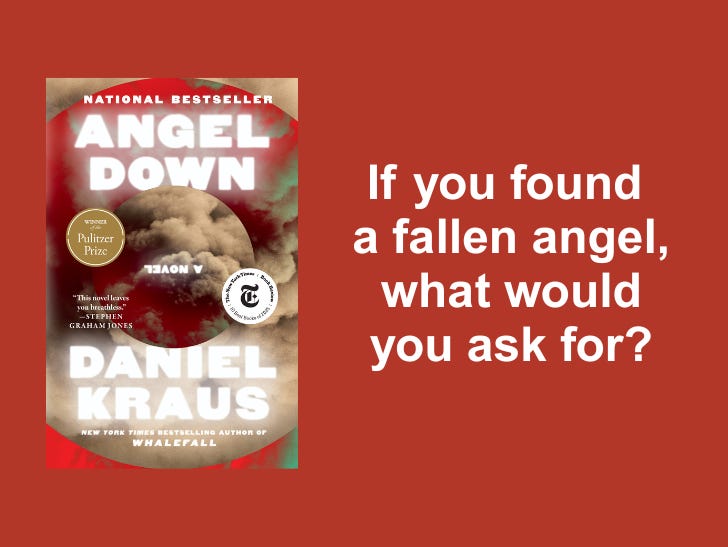
In “Angel Down,” a unit of five U.S. infantrymen rescue a fallen angel from a World War I battlefield.
The angel, with her supernatural powers, can end the war. However, four of the five soldiers and their commanding officer each have their own ideas and their own personal agendas for the angel. If they could have worked in concert with the angel to create peace, perhaps millions of lives would have been saved. Instead, they pursued individual objectives, with disastrous consequences.
“Angel Down” operates on several different levels: It’s about friendships, loyalty, father-son relationships and religious beliefs. And, to be sure, it’s about the evils of war.
But what is war if not a breakdown in international cooperation?
Kraus, I believe, wrote “Angel Down” as a lamentation on the atomization of contemporary America, on our retreat into individual silos, on our coming apart at the seams, on our narcissism and egoism.
On a national level, you don’t necessarily want everyone marching in lockstep. That can be dangerous. But there is a happy medium. We’re currently occupying the other extreme, in which we can’t even agree on what separates fact from fiction.
On an organizational level, I see the obvious benefits of unity.
At PETA, we derive power and strength and punch above our weight precisely because the entire workforce is mission-aligned. Even the IT unit is passionate about animal liberation. We collaborate and coordinate from top to bottom and across all departments.
And I know what would happen if five employees – any five employees – found a fallen angel. We would all beg her to end animal exploitation, to empty every cage, and to shutter every slaughterhouse.
Oh, how I would love to find that angel.
Excelllent posting....
And we need leaders, like you, appealing to our better Angels...